
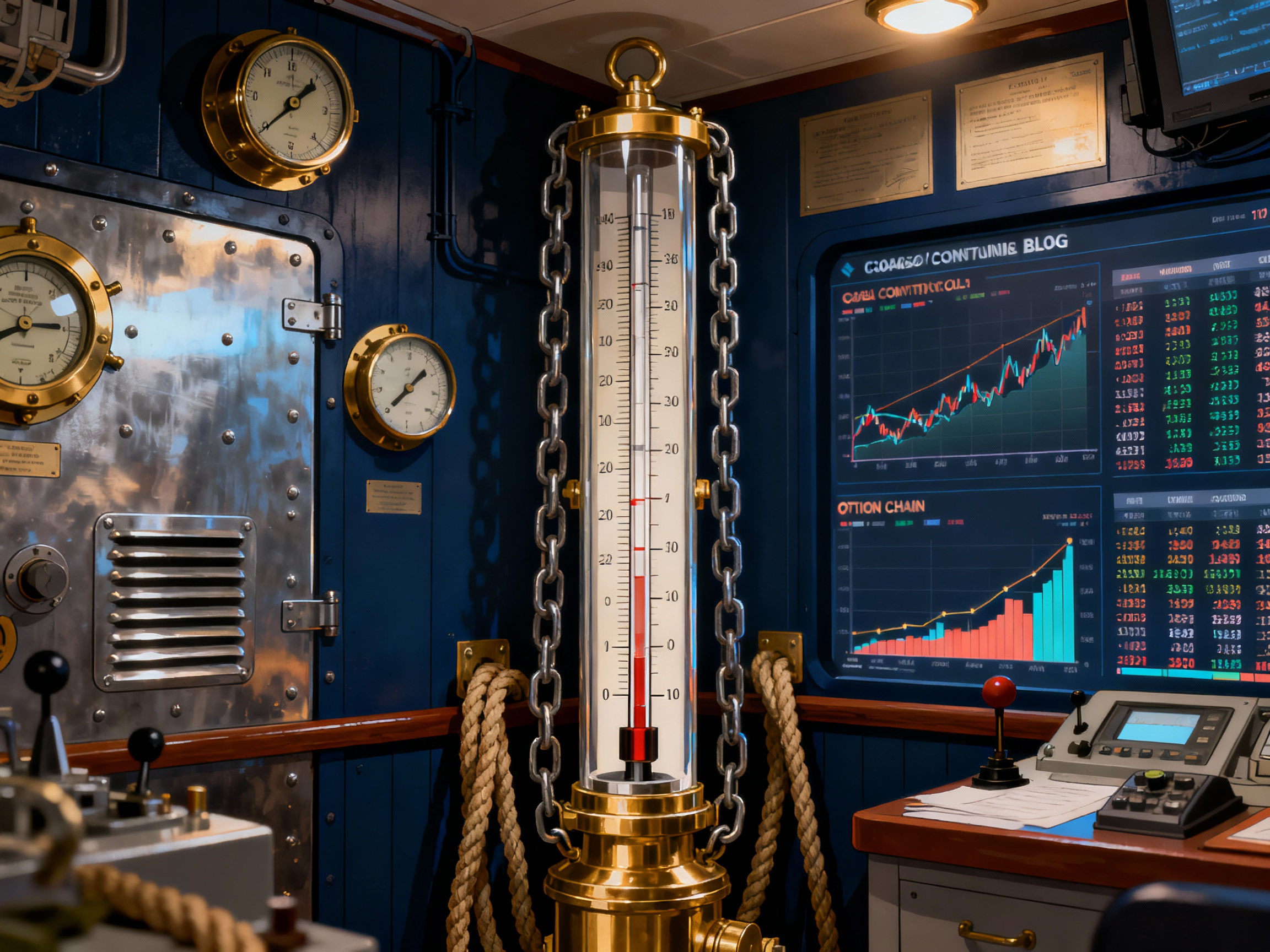
“Options are a tiger’s den—you won’t come out alive,” my shipmate warned. Yet there I was, a stubborn sailor-trader, staring at the option chain and wondering if the beast was really that fearsome.
From Wide-Eyed Cadet to Cautious Sailor-Trader
The cadet who was once awe-struck on his first sight of a ULCC now walks the deck with a quiet smile. He knows which valve to touch, which one to leave alone, and what happens when cargo starts to move. He is still a learner, but no longer a stranger. In much the same way, a few months in the market have turned our sailor-trader from a wide-eyed spectator into someone who can at least open the option chain without feeling seasick.
He now understands the basic rights and obligations: buy a call, you have the right to buy; buy a put, you have the right to sell; sell either, and you carry the obligation if the tide turns against you. He can confidently find the option chain on his broker’s terminal, spot where calls sit and where puts lounge, and identify the current market price. Yet, when it comes to actually clicking Buy or Sell, the hesitation returns. Too many numbers dance on the screen like waves in a confused sea state, and he is not sure which ones matter.
No Chief Officer on Deck
The cadet, fortunately, has a chief officer. The chief knows the pumproom like the lines on his weathered palms. From the cargo control room he loads and discharges the ULCC with the ease of a teenager on a video game console. One wrong valve and the voyage could turn into a disaster, but under his eye the operation feels almost graceful. Our sailor-trader, sadly, has no such chief officer beside him. Colleagues have only contributed ghost stories: “Options are a tiger’s den. Enter, and you won’t come out alive.” No wonder he hovers over the mouse like it’s a detonator.
Strike Price: The Backbone of the Beast
Think of the strike price column in the option chain as the ship’s draft gauge in the CCR. The glass tube is vertical, the mercury inside is the market price, and the markings on the side are the draft readings. As cargo is loaded, the mercury rises past each mark; as cargo is discharged, it falls. For the sailor-trader, each marking is like a strike price: fixed notches on a scale, while the price moves up and down.
Now imagine Nifty standing at 26,000. On the option chain, there is a neat vertical column of strike prices. For the Nifty Index, these strike prices often appear in increments of 50 points—for example, 25,900, 25,950, 26,000, 26,050, and so forth. However, for other stocks or indices, the strike price intervals may vary, as determined by the respective exchange based on factors like the underlying asset’s price level and liquidity. This flexibility ensures the option chain remains practical and reflective of market conditions.
The strike closest to the current level is called “At The Money” (ATM). It is like looking at the gauge and seeing the mercury exactly at, say, 12 metres and calling that your reference level. Many broker terminals kindly highlight this ATM strike with a different colour or a small arrow, like a helpful officer pointing: “Start here, cadet.”
ITM and OTM for Calls: Loading the Ship
Our sailor-trader now wonders: what are these mysterious “In The Money” (ITM) and “Out Of The Money” (OTM) labels? His mind drifts back to the tanker’s draft gauge. When the ship is loading, cargo flows in and the draft increases. The more she sinks, the more the submerged draft marks are “underwater.”
If he thinks of buying a call as “loading cargo,” he is happier as the price goes up. All the draft marks below the mercury are already underwater—already “in” the money. The ones above are still in the air, “out” of the money, waiting to be submerged. So, with Nifty at 26,000:
- For call options, all strike prices below 26,000 are ITM.
- The strike near 26,000 is ATM.
- All strike prices above 26,000 are OTM.
In simple sailor language: the deeper you go below the current price for calls, the more “in the money” you are. Above the current price, your call is still hoping the tide (price) will rise enough to cover it.
ITM and OTM for Puts: Discharging the Cargo
Now flip the operation. Picture the chief officer discharging the tanker. Cargo leaves, the ship becomes lighter, and the mercury in the draft gauge drops. If the sailor-trader thinks of buying a put as “discharging,” he smiles when the level goes down. For puts, happiness arrives when price falls.
In this case, all the marks above the current level are the ones already crossed by the mercury as it dives down. These are “in” the money for puts. The marks still below the mercury are the hopeful ones, waiting for the ship to rise further as cargo leaves.
So, with Nifty again at 26,000:
- For put options, all strike prices above 26,000 are ITM.
- The strike near 26,000 is ATM.
- All strike prices below 26,000 are OTM.
So the sailor-trader builds two simple rules in his logbook:
- Call buyer: wants the price to go up.
- Put buyer: wants the price to go down.
The sellers of calls and puts are like charterers who have taken the opposite bet. They are praying the sea stays calm and the price does not run too far in the “wrong” direction.
Premium: The Fare for the Voyage
By now, the sailor-trader knows that every line in the option chain—each strike on both the call and the put side—has its own trading price. This is the premium. Think of the premium as the fare you pay to reserve a lifeboat seat on a crowded ship. Sometimes the fare is cheap because nobody expects a storm. Sometimes it is expensive because everyone smells bad weather on the horizon.
This premium is not set by any captain or exchange clerk. It is a living, breathing number, constantly negotiated by buyers and sellers. When more traders want to buy a particular strike, its premium rises; when enthusiasm dries up, the premium sinks. The option chain simply displays where these fares currently stand for each strike.
Different Voyages: Expiries
One more thing catches the sailor-trader’s eye: there is not just one option chain. There are separate chains for different expiry dates—weekly, monthly, sometimes even further out. Each expiry is like a different voyage on the same route.
- A weekly expiry is like a short coastal trip: quick, choppy, and over before you’ve finished your coffee.
- A monthly expiry is more like a proper voyage: enough time to see real weather.
- Longer expiries are deep-sea journeys: slower, broader moves, and more time for both profit and trouble.
The underlying ship (Nifty or a stock) is the same, but each voyage has its own set of tickets, with its own premiums and its own clock ticking down.
Where Our Sailor-Trader Stands Now
So here stands our sailor-trader: no longer terrified of the “tiger’s den,” but cautious, like a cadet first entering the pumproom alone. He can now:
- Find calls on one side of the chain and puts on the other.
- Read the strike price column as the draft gauge of the market.
- Identify ATM, ITM, and OTM strikes for both calls and puts.
- Recognize that premium is just the live market fare for each contract.
- Switch between different expiries as if changing voyage dates.
The screen has not become less crowded, but it has become less mysterious. He still respects the warnings about wild beasts in the jungle of options, yet he also knows that even tigers can be watched safely from a well-built cage. The first cage is understanding the option chain. Pulling the trigger comes later. For now, learning to read the gauges correctly is victory enough for one watch.
The sailor-trader grew genuinely intrigued and began diving deeper, exploring books and the vast ocean of information online about option chains. With each new discovery, his fascination only intensified, as if a hidden world beneath the surface was unfolding before him. He quickly realized that stock trading—the part he had been familiar with—was merely the market’s surface waves. Beneath those waves, options formed the core, the very engine that powered the entire market and its vital energy. This newfound understanding made him see the market in a whole new light, where options were not just a side show but the heart that brought motion to all.
More to explore in the upcoming post
Further Readings:
[1] Options Chain: What It Is and How To Read and Analyze It
[2] What is Option Chain: Meaning, Components, Example
3] What is Option Chain? | Definition, Types & Significance of …
[4] Option Chain – Definition, Usages, Examples & How to …
[5] Guide to Understanding Options Chains for Indian Investors